




How Does and Should Public Transit Operate in Dane County?
2026 Annual Meeting -- Sat. Sep. 19, 3:00 - 4:30 p.m.
An Independent Voice for Buses
Welcome to the home page of Madison Area Bus
Advocates. We are a group of bus riders
and friends who aim to inform people about the reality and the possibilities
of a Madison Metro Transit, to encourage system development, and to encourage
bus ridership. We believe that good public transit supports the dignity and
freedom of all individuals, creates an open, hospitable and welcoming community,
respects the environment, opens economic opportunity to all and moves people
to where they need to go. Our vision is of a vastly improved and expanded transit
system. Will you help us get there? Join Us!
Recent Blog: First Look at Non-Drivers in Dane County
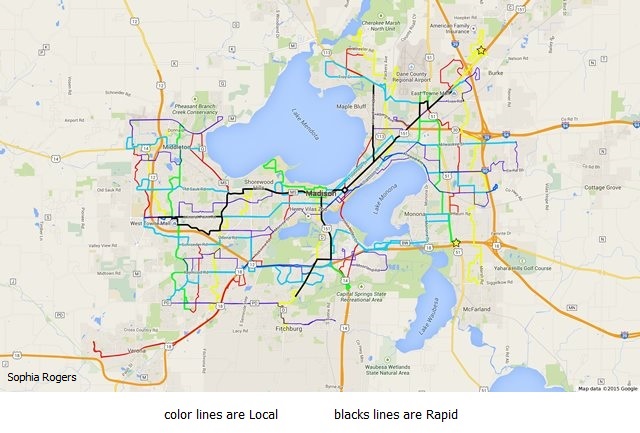 |
A Local AND Streamlined Rapid SystemWe need local AND rapid (black lines on map) transit because the area has become too large to be served adequately by only one type of bus. Rapid buses can go on major corridors and stop infrequently while local buses can go consistently in one direction, stop more frequently, and with a grid system, use naturally-occurring transfer points. System design should enable heavily-used lines to be converted to light rail in the future. Read More |
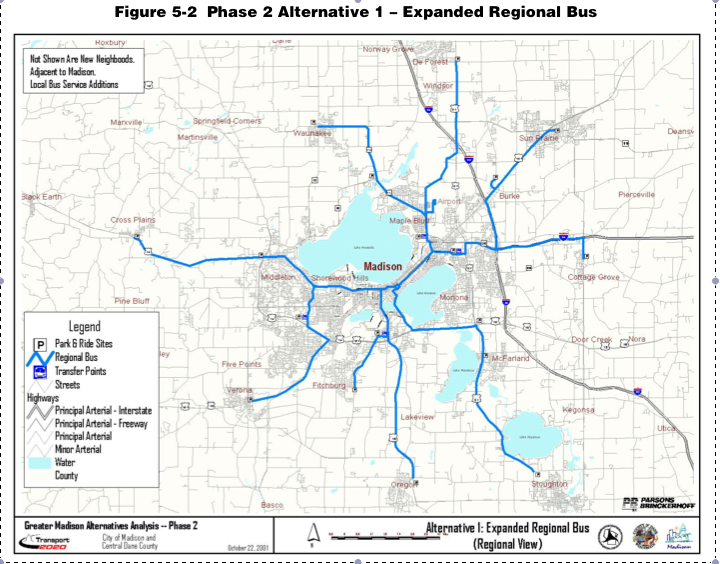 |
Opinion: An RTA in Dane CountyWe need a Dane County RTA that can cover both capital and operational expenses. The priorities of a socially fair and fiscally-responsible RTA here should be to 1) establish seamless, accessible and safe terminals for inter-city and intra-city transit, 2) coordinate with other mobility means to address the "last mile" issue, 3) expand transit availability within and outside Madison, 4) make transit competitive with the automobile for affordability, time and convenience, and 5) add shared-ride taxis, circulators, shuttles and demand-response vehicles for small populations. Read more |
 |
Positions |
"We’ll be the first generation in the history of the planet that drove to the poorhouse in an automobile” - Will Rogers, 1931